Patios in Spain - An architectural approach for travelers
Updated March 31, 2026.
All images are courtesy of the Spain Less Traveled team, unless otherwise stated.

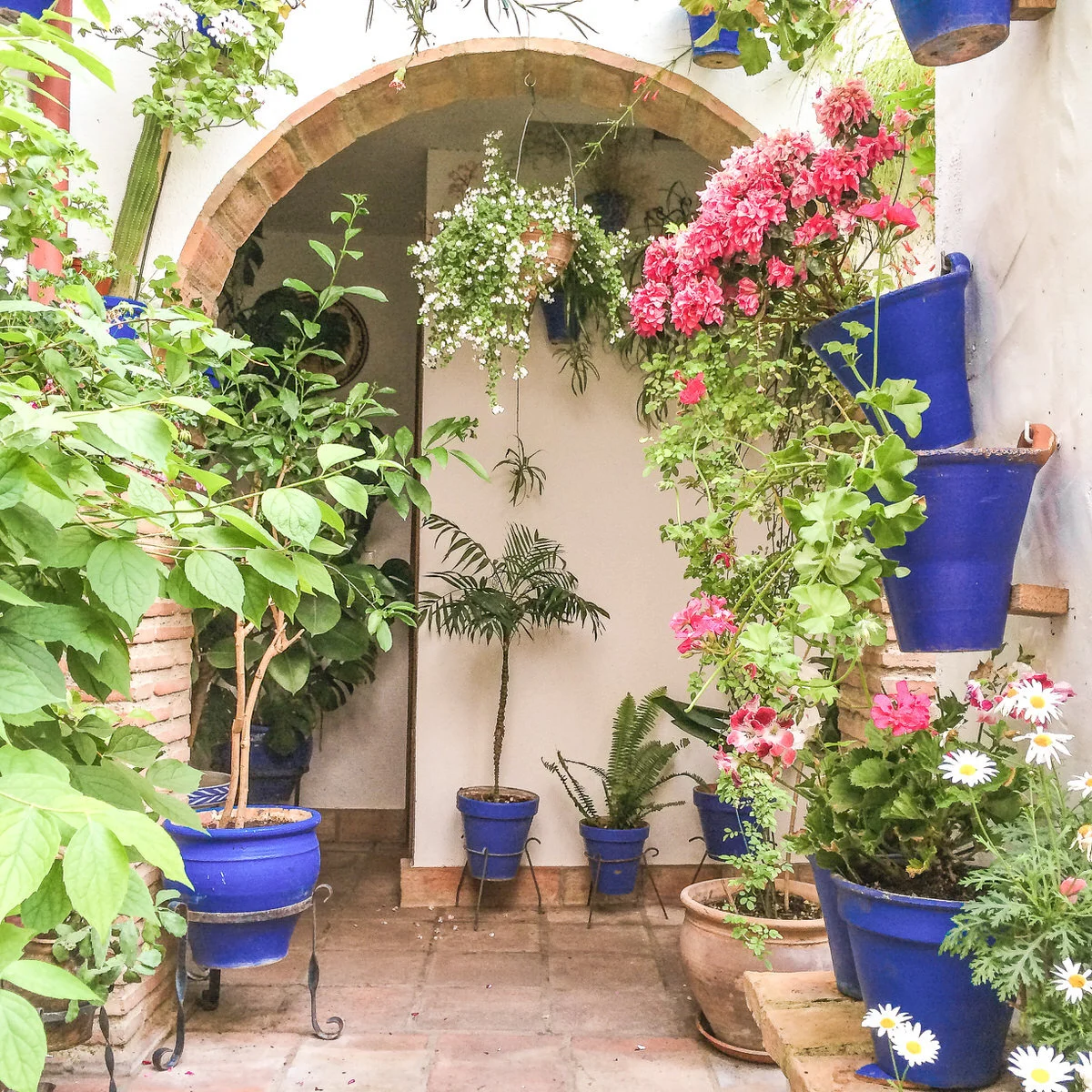
Blue flower pots in Córdoba
A little background: Roman Houses
According to some sources, the word ‘Patio’ (Spanish for ‘courtyard’) comes from the Latin ‘patulum’ or ‘patium’ and it makes sense, as the patios in Spain have their origin in Roman houses. The Romans occupied the Iberian peninsula for 700 years, creating big cities, with big houses for its richest citizens.
These ‘Patrician’ houses (or Domus) were organized around a courtyard with plants and fountains. This was done for two main reasons:

Sketch taken from Del Toro & Antúnez Arquitectos blog
Privacy: To reduce the number of windows to the exterior. Most rooms open to the patio giving freedom of movement and activity to the inhabitants without looks from the outside.
Temperature: It’s a perfect system for hot weather. The small windows to the exterior create a flow of air from the patio opening through the rooms. The water and greenery in the patio cools that air and the portico of the patio creates a shadow in the rooms walls, also cooling them.
The patios were also the place to display the family statues and the bigger the patio, the more important the family. There were even houses with several patios, some public, used for receiving guests and others private, for enjoyment of the family.
There are very little remains of Roman houses in Spain, but some nice reconstructions like the one close to Reinosa, in Cantabria, that can be visited.


Houses in Pompeii (Italy)
Patios in Spain
This model was also used in Roman houses in the north of Africa, and that’s the route that the Moors took to arrive in Spain. Their domination was a little longer than the Romans’ and it had a bigger influence on Spanish architecture. As the Quran doesn’t allow the representation of humans or animals, there were no statues, but rich decoration with vegetal or geometric motifs.
There are many examples of Moorish houses in Spain. For instance, the city of Granada has restored many of the old biggest Moorish houses of the city to their former splendor. These are great places to visit if you want to see some beautiful examples of patios in Spain.


Moorish houses of the Albayzin in Granada, Spain
Even though the Moors were expelled from Spain in the 15th century, the patio model remained, as it adapted perfectly to the local climate, especially in the center and south. You don’t see houses with patios in the north of Spain, as the climate is cold and you need to keep the heat generated by fire inside.
But in Southern Spain, particularly Andalucia, you can find patios in big Baroque palaces or small traditional houses
The model was also exported to then Spanish domains, like Latin America, where colonial houses are also organized around patios. So these types of patios in Spain can also be found outside of Spain.

Patio at a school in Merida, Mexico.
Cordoba: the most beautiful patios in Spain
But Cordoba turned the patios in Spain into works of art. Cordoba patios are not for the lovers of minimalism. They are lush, loud and a little insane. The use of greenery is taken to the extreme, and as most of them are small, plants and flowers climb the walls, invade any free space and merge with the architecture. ‘Tiestos’ (or flower pots) become architectural elements through iteration.
“We highly recommend la Fiesta de los Patios Experience. The patios were gorgeous! I have been traveling through Spain for the first time in the last two months with my daughter (a resident of Spain). Each area and city that I have visited is unique and filled with history, beautiful architecture, and offerings. I am so glad we added the three days in Cordoba to our itinerary.”
More client testimonials here.
Patios become the living room of the house. The place to rest, to share with the family and receive and entertain visitors. And especially during one of our favorite festivals: la Fiesta de los Patios they became an extension of the urban space, as everybody can go in, absorb their beauty and meet new people. Social acts like concerts or readings are organized inside them, for everybody to join. This festival is a wonderful way to see the patios in Spain on an up-close and personal level!


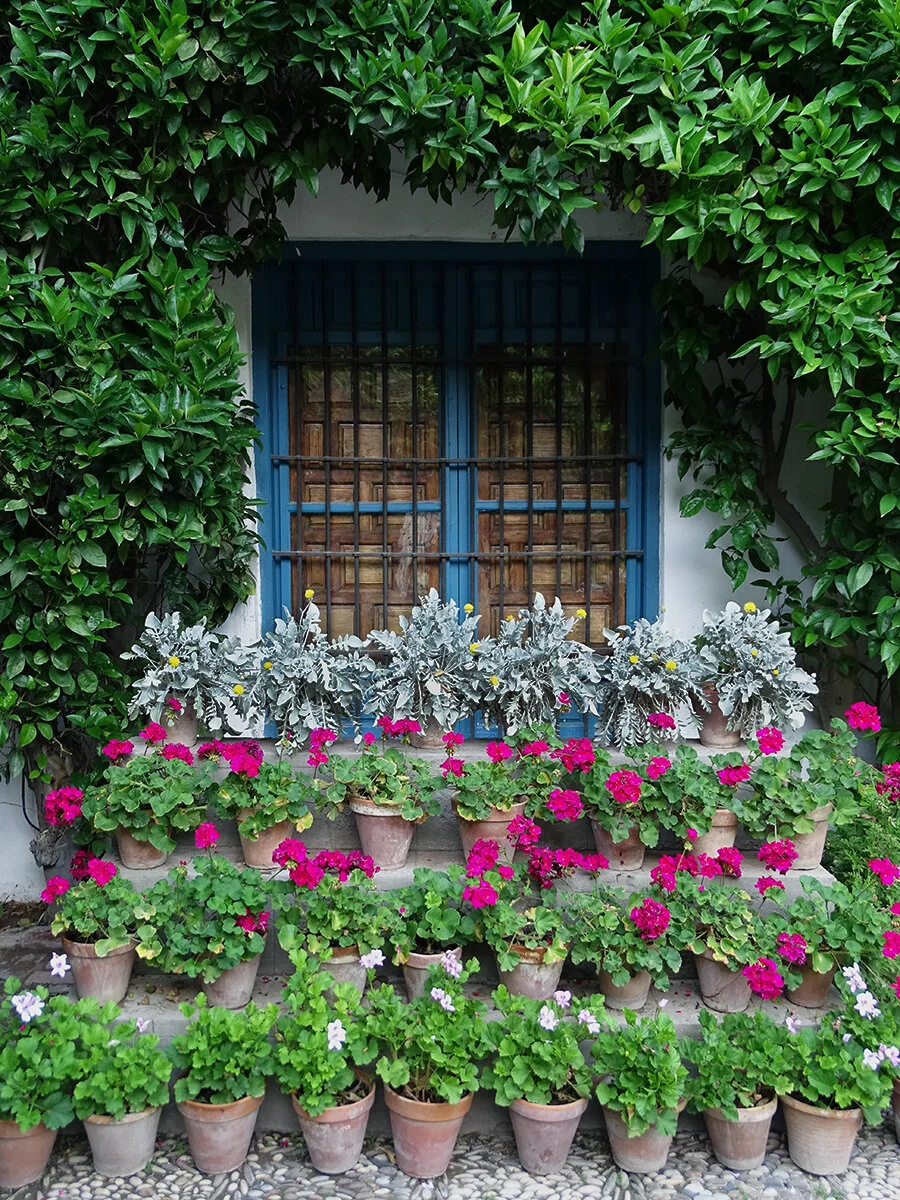

Examples of Cordoba Patios, the first four are private patios and the last two (bottom right and center) are Palacio de Viana, open year round. Cordoba is a great place to visit the patios in Spain!
How to Visit

Time your visit well
The best time to see patios is in May, during Córdoba’s famous festival.
Go early or late in the day
Focus on the right neighborhoods
Look for open doors
Be prepared for short visits
Check access in advance
Tips for First-Time Visitors
Adjust your expectations
These are not grand tourist sites—they’re intimate, lived-in spaces. That’s part of their charm.
Respect privacy
Don’t rush
Pair with a walking route
Expect crowds in peak season
Stay hydrated
Where Else to See Patios in Spain?
Seville
Patios are everywhere in Seville—often tucked inside historic homes, small hotels, and palaces. Look for them in the Santa Cruz neighborhood or inside landmarks like the Alcázar.
Granada
In the Albaicín quarter, many traditional houses feature patios with views of the Alhambra. Some are open as part of small museums or guesthouses.
Madrid
Less expected, but still worth noting—historic buildings and cultural sites in Madrid sometimes have hidden courtyards, especially in older districts.
Toledo
Patios in Toledo appear inside restored homes, convents, and boutique hotels, often blending Christian, Jewish, and Moorish influences.
You might like our post: Sephardic Spain.
Boutique Hotels
Many historic properties, especially Paradores in Spain, have beautifully maintained patios that guests can enjoy in a quieter setting.
Inspired by the history and architecture of Patios in Spain?
If you’re planning a trip to Spain and want to experience patios in a more meaningful, well-paced way, Spain Less Traveled can help you build an itinerary that includes them naturally—without the guesswork.
More about Carlos

Carlos is an avid photographer
Carlos Casuso is an architect living and working in Madrid since 1991. Specialized mostly in retail design he recently created his own studio: Amanece – Design on the Rise.
Among his many projects, he designed the Rainbow Honor Walk, in San Francisco, California. It’s a set of plaques all over the city, honoring LGBTQ individuals who made a difference in the world and helped to advance the cause of rights. You can see the designs, and donate for its future expansions at www.rainbowhonorwalk.org
Casuso is also an active traveler, having visited almost 70 countries around the world. And of course, all his family comes from Cantabria.
Ready to start your journey?
Book a FREE 15 minute discovery call
to help you decide which of our professional Spain travel planning services suits you best.